


What research allows us to say about infrared and exposure to heat.
Infrared and controlled heat exposure are the subject of scientific work in various fields: thermoregulation, circulation, physical recovery, pain, relaxation, sleep, and physiological responses to heat.
At Infracab'in, we have chosen a simple approach: to distinguish what is documented, what remains to be explored further, and what cannot be stated as fact.
This requirement guides both our communication and the development of our solutions.

When the body is exposed to heat, it activates several thermoregulation mechanisms. Skin temperature increases, superficial blood vessels dilate, cutaneous blood flow changes, and perspiration contributes to heat dissipation.
These physiological responses are well documented. They constitute the scientific starting point for understanding the effects of controlled heat exposure.
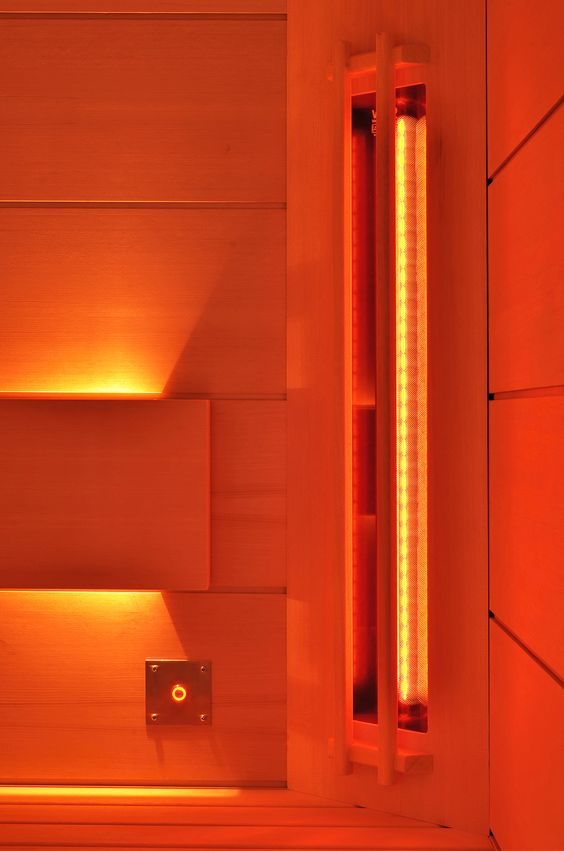
Traditional sauna, far infrared, near infrared, broad spectrum lamps, local or whole body exposure: the technologies and protocols studied are not interchangeable.
A study conducted with a traditional sauna does not automatically allow for the same results to be attributed to an infrared cabin. Similarly, results obtained with a given wavelength, power, or exposure time cannot be extrapolated to another technology without careful consideration.
This is why Infracab'in systematically distinguishes the technology studied, the protocol used and the population concerned before communicating on a scientific result.
At Infracab'in, we want to go beyond existing literature and document the use of Direct Heat® in real-world conditions.
An evaluation process is currently being structured to study, according to a defined protocol, various parameters related in particular to recovery, sleep, stress, fatigue and user experience.
This approach aims to rely on measurement tools and evaluation criteria defined beforehand, in order to collect usable data and progressively improve our knowledge and usage protocols.
At this stage, no result is presented as established: the objective is precisely to measure before making any assertions.
Research on heat exposure and various infrared technologies now covers many areas: physical recovery, muscle comfort, sleep, stress, heat adaptation, and physiological responses.
At Infracab'in, we select and analyze scientific publications taking into account the technology studied, the protocol, the population concerned and the limitations of each study.
Because a scientific study never constitutes a promise of individual results, we always distinguish between knowledge from scientific literature, our evaluation methods, and user feedback.
There is a body of scientific literature dedicated to heat exposure and various infrared technologies. However, the level of evidence varies depending on the effect studied, the technology used, the protocol, and the population involved. It is therefore preferable to discuss documented results on a case-by-case basis rather than attributing «proven benefits» to infrared radiation in a general way.
Not automatically. Both technologies expose the body to heat, but under different conditions. The results must be interpreted taking into account the technology and protocol actually studied.
No. Their wavelengths and absorption characteristics differ. Therefore, their interaction with tissues is not identical.
Infracab'in is developing a process for evaluating its uses in collaboration with independent experts. The results are presented by clearly distinguishing between published scientific data, specific evaluations, and user feedback.
No. Infracab'in solutions are not medical devices and are not intended to diagnose, treat or cure any disease.
They are designed for uses related to well-being, comfort and recovery, and are also used by healthcare professionals and therapists, who integrate them into their practice according to their own protocols and within their scope of practice.
No. The response to heat depends in particular on individual characteristics, state of health, intensity and duration of exposure as well as conditions of use.
We believe in the benefits of a technology when they can be explained, studied, and documented.
This is why Infracab'in pursues an approach based on scientific literature, evaluation of its uses and collaboration with independent experts — without transforming science into a medical promise.